This article was originally published as part of the AAJA Voices program. It can be read here.
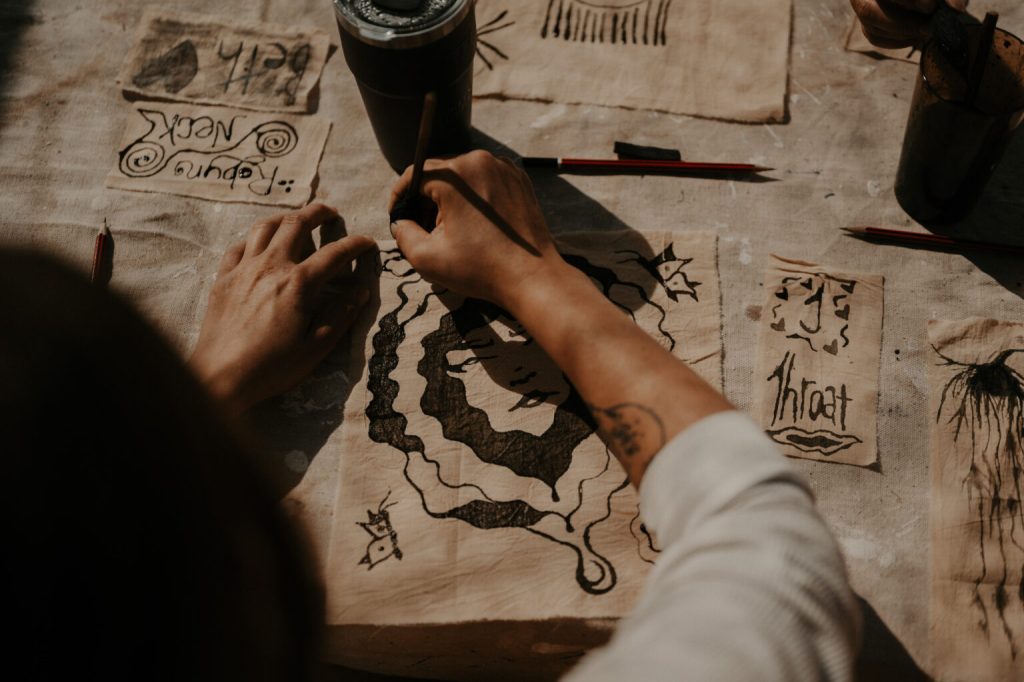
In a bright Brooklyn apartment, young professionals gather around a large wooden table, learning to work with natural dyes and the bamboo pens traditionally used in making kalamkari, an ancient artform from rural Andhra Pradesh in southeastern India. Artisans have practiced these techniques for generations in making tapestries and saris, yet kalamkari — literally “pen work” — has found new life in New York City, carried forward, in some cases, by people who had never been exposed to the culture around it before.
Artist Nikita Shah’s path to becoming a kalamkari teacher in New York began with her eight-year tenure as a designer with Gaurang Shah, a luxury brand based in India. Growing up in India, she had been surrounded by traditional crafts without fully appreciating them. “People didn’t like kalamkari as much as they do now,” she recalled.
One of her many works is a recent project called ‘At Home in Brooklyn.’ After months of kalamkari workshops held at the Brooklyn Community Pride Centre and GRIOT senior center, more than 30 participants created a communal kalamkari story cloth. Most of the participants in this project belonged to queer and other marginalized communities of New York. For Shah, this was a direct representation of the origins of kalamkari as a craft in India.
“It goes back to … pre-colonial, pre-Hindu temple patronage,” Shah explained. “There have been histories of kalamkari written by lower-class people, people who didn’t have a voice in society. I think about who the people are who don’t have a voice today, and how do we safeguard their stories.”
The artwork was showcased at Brooklyn Arts Council earlier this year.
 The Village Market
Leave a comment